

A chara,
I hope that you are keeping well.
I heard you were hoping to hear of some lesser known Irish heritage stories. Now rather than chatting to you about St. Patrick or leprechauns, I hope you don’t mind if I share a beautiful legend that began at the time of St. Patrick that tells about a gift of music from the Sidhe (Irish fairies) below. It is one of my favourites and you will see why in a minute.
In the time of St. Patrick and as early as the 5th century, an Irish family called the O’Cahan clan, (known today as the Ó Catháin, O’Kanes, Kanes, Canes, Cain’s and McCain’s and so on), were found throughout Coleraine and Limavady in Northern Ireland. By 1100AD, the seat of the O'Cahan Clan, Dungiven Priory was founded, overlooking the River Roe. Within it lies the tomb of Cooey-na-Gall, an ancient Chieftain of the O'Cahan clan. A few feet away, lies a healing wart well and a fairy rag tree.
The O’Cahan became strong and influential, but in 1608, the last of the influential lords, Domhnaill (Danny) O’Cathain, (also known as Donnell Ballagh O'Cahan) was captured and held in the Tower of London until his death in 1626. The time of the O’Cahan’s was over.
Before resigning their lands and castles to London, the O’Cahan chieftain, a great harper and composer named Ruaidhrí Dall Ó Catháin (also known as Rory Dall O’Cahan) did what all O’Kane’s do well. He threw one last great party at his remaining castle to celebrate all that had gone before them and to commiserate all that was ahead of them. As the party began to die down into the early hours, Rory became overcome with grief and drink. He slipped out quietly to sit at the bank of the River Roe and fell asleep.
Local Limavady legend says he awoke surrounded by a soft mist from the river. As he looked out across the river, he realised he was surrounded by the Sidhe (fairies). They began playing the most beautiful, haunting music. The lamenting music echoed his unmatched despair at the ruination of his family, future and the fall of one of Ireland’s oldest kingdoms. Returning to the party, he picked up his harp and replayed the music by ear, swearing that it had come from the Sidhe. The song became known as O’Cahan’s lament.
Down through the following 240 years it began to be played less and less by pipers, fiddlers and harpists, almost forgotten, until in 1851, Limavady schoolteacher and Irish folksong collector Jane Ross heard blind fiddler Jimmy McCurry playing the haunting melody outside her house on Main Street during a fair. She couldn’t help but take note of the pain and sadness of the music against the upbeat fair atmosphere. She invited him in and paid him two shillings for permission to write down the music. She sent the music to a magazine which published the tune as The Londonderry Air.
While many lyrics were written for it throughout the 19th century, it was only in 1910 that Englishman, Frederick Weatherly wrote the ballad Danny Boy which fit the music so effortlessly. The song began to spread across the world. Elvis Presley once called it “music written by the angels,” and it was played at his funeral.
Today the song Danny Boy is believed to be among the three most performed songs in the world, alongside “Happy Birthday to You” and “White Christmas”.
In Limavady it is said, that only music as emotive as this, composed in a moment of utter sorrow, having almost become lost to time, that has entranced the world and finally, which has circled back to be named the same name as Limavady’s last imprisoned lord, Domhnaill (Danny) O’Cathain, could only have come from the fairies.
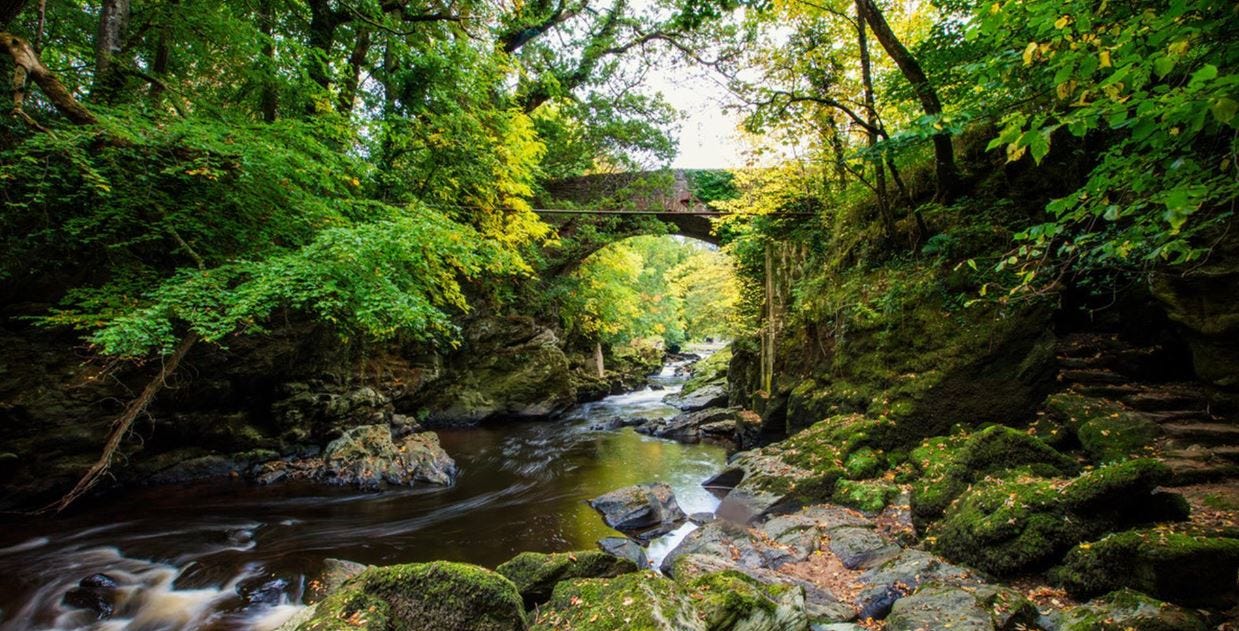
If you are thinking of visiting where this story took place when you next come home to Ireland, then this little photograph has details on the back. Otherwise the family might enjoy seeing it.
I hope you enjoyed this story as much as I did sharing it and I will write to you again soon.
Beir bua agus beannacht,
Róisín Hynes
Sliocht sleachta ar shliocht bhur sleachta.
This is something of a Scottish anthem, at least in my family. But as an O'Kane, who traces my family back to the 15th Century I can't even tell you how touched I was to read this. Thank you for keeping these stories alive. I'm very glad I found and subscribed to your content.
This has been sung at every male funeral in my family for years! So happy to know the history of the song!